
75-ball bingo: how many calls until a 5×5 card completes its first line
Published — UTC
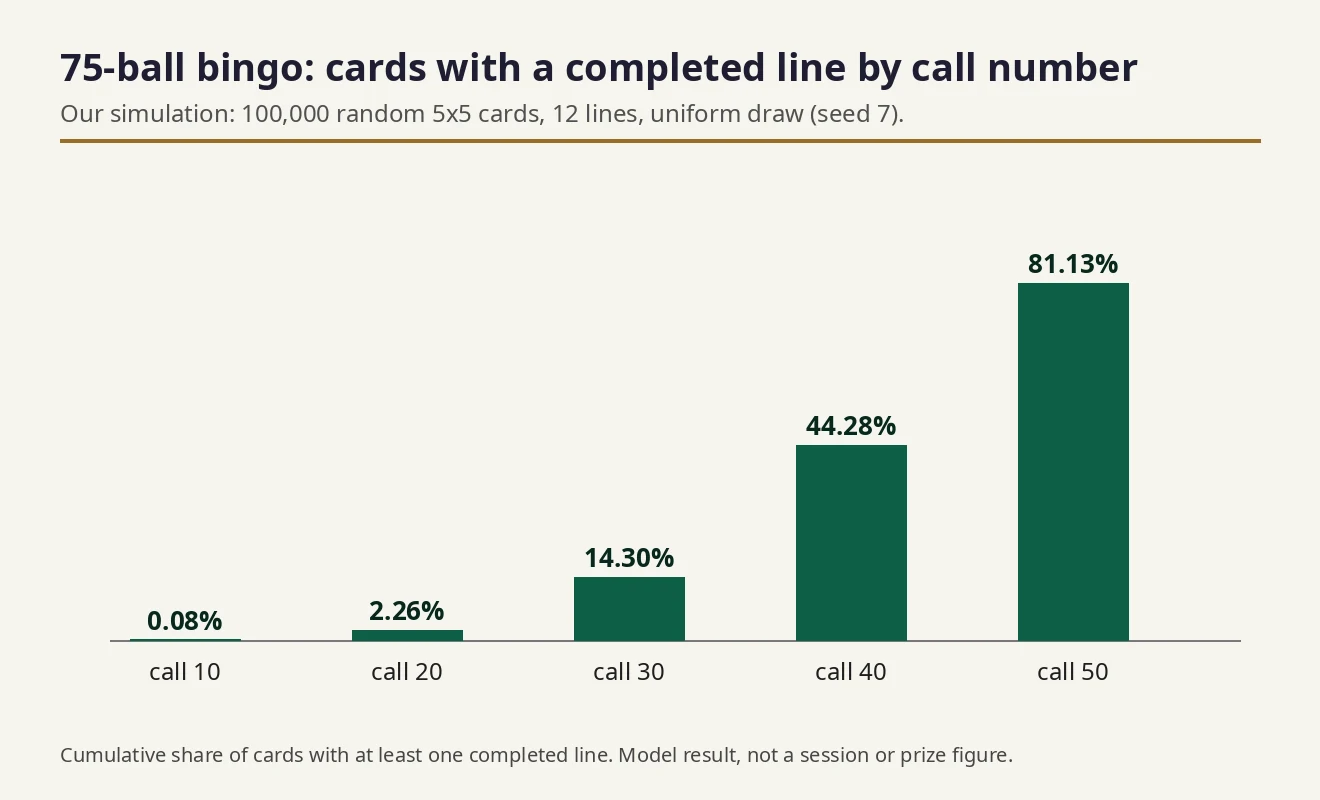
Short answer: On a standard 75-ball card with 12 possible lines, our simulation of 100,000 random cards finds that about 2.3% have completed a line by call 20, about 14.3% by call 30, about 44% by call 40 and about 81% by call 50. The median card completes its first line at call 42. These are results from a model with stated assumptions, not a claim about any particular game or operator.
What the model assumes
We used the common 75-ball layout: five columns, each drawing from 15 numbers (B 1–15, I 16–30, N 31–45, G 46–60, O 61–75), with the centre square free. A line is a full row, a full column or one of the two diagonals, giving 12 lines in total. Every card has 24 numbers drawn at random inside its column ranges. The 75 balls are drawn in random order without replacement, so every number is called exactly once.
Real games set their own pattern rules. Some pay only on full cards, some use a fixed pattern, and some restrict which lines count. Different rules change the answer. This article covers only the single-line case.
Line completion by call number
The table gives the cumulative share of cards that have completed at least one line by each call. Each row is our simulation result; the margin of error is about ±0.3 percentage points at 95% confidence for the larger values, and smaller for the smaller ones.
| Call number | Cards with at least one line (simulation) | Reading |
|---|---|---|
| 10 | 0.08% | Almost no card finishes a line this early |
| 20 | 2.26% | About 1 card in 44 |
| 30 | 14.30% | About 1 card in 7 |
| 40 | 44.28% | Close to a coin toss |
| 50 | 81.13% | Most cards have finished a line |
| 75 | 100% | Every card finishes by the last ball, because all 75 numbers are called |
The median first-line call in the same run was 42, and the mean was about 41.4. The distribution has a long early tail, so the mean and median sit close together only because most cards finish in the middle of the draw.
Why a line is not the same as a prize
The table measures when a card first has a line. It does not say what that line pays. Prize tables, claim rules and whether a line can be shared between players all sit outside the model. A line that completes early may pay the same as a line that completes late, or it may pay nothing if the game requires a different pattern. Check the rules of the game you play before reading these numbers as expected winnings.
The next ball has no memory, but the odds still change
Each draw is independent in the sense that the balls do not remember earlier calls. The odds still change during the game, because the pool of uncalled numbers shrinks. The arithmetic below is ours and follows from the draw rules.
- At the start, a specific uncalled number has a 1 in 75 chance of being called on the next draw.
- After 40 calls, 35 balls remain. If the card still needs one specific number, that number has a 1 in 35 chance (about 2.86%) on the next draw.
- That is why later calls finish more cards quickly. It is not a pattern in the balls. It is the shrinking pool.
What this does not show
- No real games. We did not observe any bingo session or operator’s draw. The table is a model of a uniform random draw.
- No prize or house-edge figures. Cards cost money and prizes depend on the operator’s rules, so this article makes no claim about expected return.
- No source for pattern rules. The only external input is the 75-ball layout, which is a common convention rather than an official rule of any specific game.
Before any real-money decision
Bingo for money is gambling. Eligibility in the Philippines depends on age and other rules, and the regulator publishes its own guidance. Check the PAGCOR guidance before any real-money decision. This page is information only. It does not offer play, sign-up or deposit links.